Education is widely recognized as the foundation of sustainable development, community health, and economic mobility. Yet across Liberia, the path to completing basic schooling remains a steep uphill climb for hundreds of thousands of young people. Behind the national statistics lies a complex story of historical recovery, economic hardship, and a generation striving to learn against significant odds.
The Scope of the Out-of-School Challenge
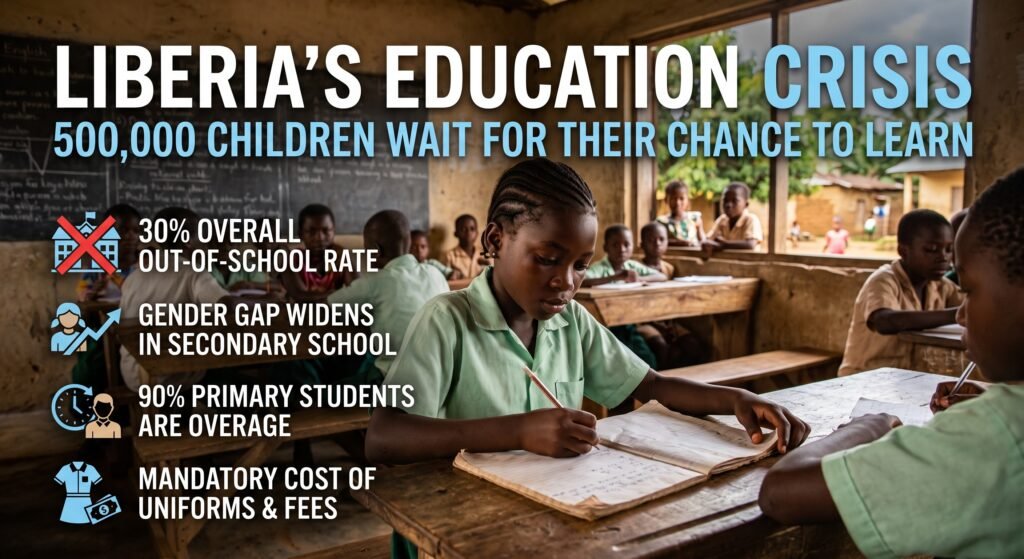
Data from UNESCO and international education agencies shows that approximately 30 percent of children and youth in Liberia are currently out of school—representing nearly 500,000 young people nationwide.
While primary enrollment has expanded over the last decade, retention remains a critical issue:
- Primary Completion Rates: Only about 58% to 62% of students who enter primary school successfully finish it.
- Secondary School Drop-Off: By lower secondary school, completion rates fall to roughly 45%.
- The Gender Gap: While boys and girls enroll at relatively equal rates in early grades, completion rates for lower secondary school drop significantly for girls (41%) compared to boys (50%).
The Overage Enrollment Phenomenon
One of the most defining characteristics of Liberia’s education sector is the widespread occurrence of “overage enrolment.” According to reports by IIEP-UNESCO, over 90% of primary school students in Liberia are older than the official age for their grade level.
This pattern stems from several factors:
- Late Entry: Many children do not start first grade at the official age of six due to long travel distances, household economic constraints, or security concerns in rural areas.
- Interrupted Education: Families frequently have to pull children out of school for seasons at a time when unexpected agricultural or financial shocks hit.
- Increased Dropout Risk: As overage students enter adolescence while still in primary grades, social pressures, the need to earn an income, or domestic responsibilities make them exponentially more likely to leave school permanently before finishing their basic education.
Structural Obstacles: From Fees to Classrooms
While public primary education is technically free under Liberian law, the hidden costs of schooling remain a substantial barrier for low-income households. Mandatory costs for uniforms, shoes, textbooks, examination fees, and basic stationery often equal a significant portion of a family’s monthly income.
Beyond household finances, structural deficits within the school system itself present ongoing challenges:
- Infrastructure Deficits: Many rural communities lack adequate school buildings, sanitation facilities, or clean water access.
- Teacher Supply & Training: There is a persistent shortage of certified teachers, particularly in specialized subjects like mathematics and science, as well as in remote rural districts.
- Learning Poverty: According to World Bank regional assessments, high enrollment numbers do not always translate directly to learning outcomes; many students complete early grades without acquiring basic foundational literacy and numeracy skills.
Looking Ahead
Addressing these systemic challenges requires sustained effort across multiple fronts: strengthening teacher training programs, building localized infrastructure, supporting community-led initiatives, and reducing the direct financial burden on low-income families.

Getting children into school is one thing, but helping them stay in school, learn, and finish is another. There are so many factors involved. Where do we start as a community?