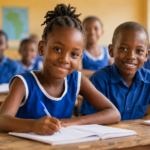
Sometimes, what stands between a child and an education is not a lack of desire to learn. It can be something as simple as a uniform, a pair of shoes, notebooks, transportation, or the cost of getting through the school door.
A recent UNICEF Liberia story from Buchanan brings this reality close to home. It tells the stories of families struggling to keep their children in school because of financial hardship. Among them is 14-year-old Fayor, whose journey included years away from the classroom and selling charcoal before receiving an opportunity to return to school.
Her story makes you stop and think.
For many of us, a backpack is simply a backpack. A notebook is something we replace when the pages run out. A school uniform is part of getting dressed in the morning.
But for a family already choosing between food and other necessities, these ordinary things can become extraordinary expenses.
And for a child, not having them can mean much more than going without material possessions. It can mean embarrassment, exclusion, falling behind, or eventually leaving school altogether.
The Small Things Are Not Always Small
When we talk about improving education, the conversation often turns to classrooms, teachers, textbooks and examination results. All of those things matter.
But sometimes we need to look at education through the eyes of the child standing outside the classroom.
Does she have what she needs to attend?
Does he have something to eat before trying to concentrate?
Does the child have shoes, a uniform and basic school supplies?
Does the family have enough support to keep choosing education when money is scarce?
These questions remind us that access to education is about more than having a school nearby.
A Second Chance
Perhaps the most powerful part of stories like Fayor’s is not simply the hardship. It is the possibility of another chance.
A child who has fallen behind is not necessarily a child without potential. Sometimes that child simply needs someone to remove one barrier and open one door.
That help does not always have to be enormous.
A backpack can carry books.
A pair of shoes can carry a child to school.
A meal can help a student concentrate through the afternoon.
A notebook and pencil can give a child the tools to participate alongside classmates.
And encouragement can remind a young person that someone believes their future is worth investing in.
The question these stories leave us with is simple:
How many children could move forward if one small barrier were removed from their path?
Perhaps meaningful change does not always begin with doing something big.
Sometimes, it begins by noticing the small things.
Source: UNICEF Liberia, “Three Mothers, One Hope: Back to My Classroom in Buchanan,” June 3, 2026.
Take a look and let me know what you think.